Cold Open, Not Cover Letter: The Hundred-Word Statement That Gets You Read
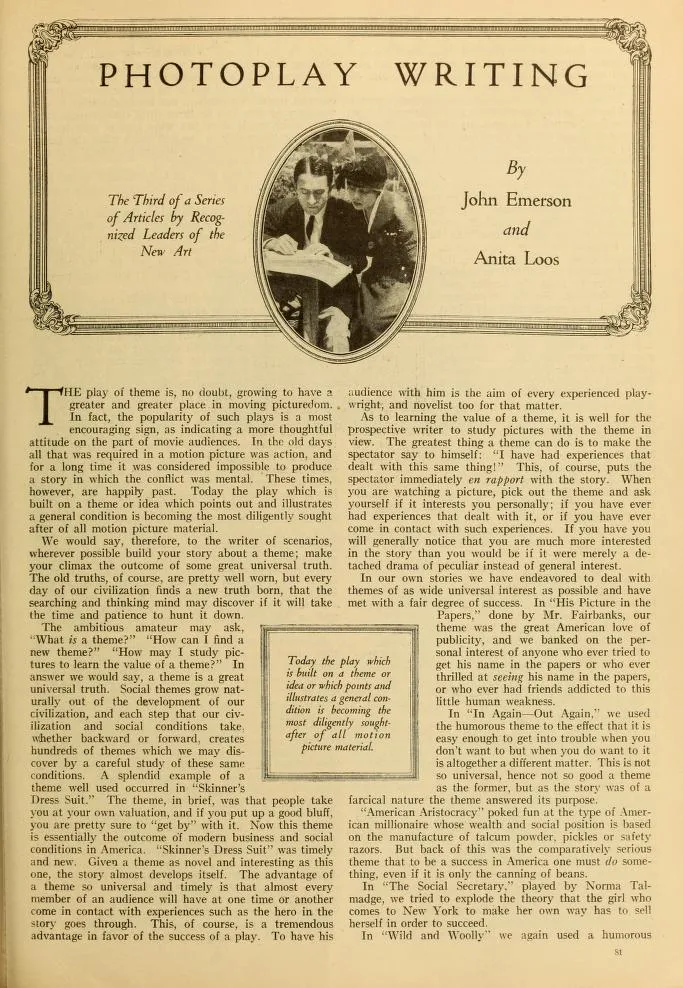
Photo: Photoplay Magazine, Public domain, via Wikimedia Commons
There's a particular hush that falls over a festival submissions queue in the last week before the deadline. Somewhere in that pile is a one-page PDF, and on that page a filmmaker has about a hundred words to convince a stranger — tired, caffeinated, four hundred links deep — that the next eleven minutes are worth their evening. Most of those hundred words get spent on the wrong things.
Here's the reframe that changes everything: the statement isn't paperwork. It's the first scene of your film that a programmer encounters. It should play like a cold open — something already in motion, already carrying a voice, that makes you want to see where it goes.
The Statement Is Not a Synopsis With Feelings Attached
A synopsis tells you what happens. A statement tells you why it had to happen this way, by this person, in this form. Those are different documents, and confusing them is the single most common failure in the whole application packet.
Programmers read hundreds of loglines and still remember the good statements, because a good statement does something a logline can't: it transmits tone. It lets them hear the film before they watch it. If your short is a dry, deadpan thing with long static shots, your statement should feel dry and unhurried. If your film is a ninety-second burst of chaos, the statement should move like a handbrake turn. The prose is a preview of the cut.
Three Habits That Flatten Every Statement
The first is recap. "The film follows Maya, a grieving beekeeper, who must confront her past when..." Nobody has seen your film. They don't need the plot; they need the pressure that made you write it. Recapping spends your hundred words on a job the logline already did badly.
The second is apology disguised as humility. "Made for almost nothing, in three days, with a crew of friends..." Programmers know. Every short at every festival was made for almost nothing in three days with a crew of friends. Leading with the constraints tells them you think the budget is the interesting part. It isn't.
The third is the thank-you parade. Save the gratitude for the crawl. A statement that lists fourteen collaborators is a statement that has forgotten who it's talking to.
What replaces them? Three things, roughly: a specific image or moment, the question you were chasing, and one honest note about the method that shaped the result.
A Before and After
Here's a real-shaped before — the kind of paragraph that lands in inboxes every single day:
"I have always been passionate about storytelling and the human condition. Low Tide, High Water follows a family dealing with loss and the bonds that hold us together. This film is deeply personal and was made with an incredible team who gave their time and talent for almost nothing. I am so grateful to everyone who helped bring this vision to life and I hope audiences connect with its message about love and loss."
Seventy-two words, and not one of them is a reason to press play.
Now the after:
"Last March my uncle sold the family boat and didn't tell anyone for six weeks. Low Tide, High Water is an eleven-minute film about the silence that fills a house after a decision like that. We shot it in one afternoon at a marina outside Duluth with three non-actors, no script, and a sound recordist who kept apologizing for the wind. I wanted to make something that felt like the ten minutes after an argument ends. If it works, you'll leave a little seasick. If it doesn't, you'll know exactly which wave I missed."
Ninety-nine words. Same film. Completely different odds.
The Hundred-Word Shape
You don't need a formula, but you do need a shape, and this one survives contact with reality:
- Open with a concrete fact, not a feeling. A date, an object, a thing someone did. Specificity is the fastest shortcut to trust.
- Name the film once, plainly. Title, length, and the one sentence that locates it.
- State your method in a single clause. The constraint that actually shaped the work — not the budget, but the choice. No script. Three non-actors. One location. Shot on expired stock.
- Ask the question you were chasing. Not the theme — the question. The one you don't fully know the answer to.
- Close with an out point. A last line that lands like a cut to black, not a fade to a thank-you.
Draft it long first. Then start cutting adjectives. Then cut the second-best sentence in every paragraph, because when you're writing to a word count, your second-best sentences are just padding with good posture.
Write It the Way You'd Cut It
Read your statement out loud at the pace of your film. If it stumbles, it's long. If it explains itself twice, it doesn't trust the reader — and if you don't trust a programmer with a hundred words, they'll assume you don't trust an audience with eleven minutes.
One more pass: cover the title and read only the statement. Could it belong to any other short in the pile? If yes, keep digging. The hundred words you're looking for are the ones only your film could have produced — the marina in Duluth, the boat nobody mentioned, the wind on the track.
Write that. Then hit submit, and let the statement do what a cold open does: make someone stop scrolling and stay.