The Last Hundred Feet: Inside the Booth Where Your Short Meets Its Audience
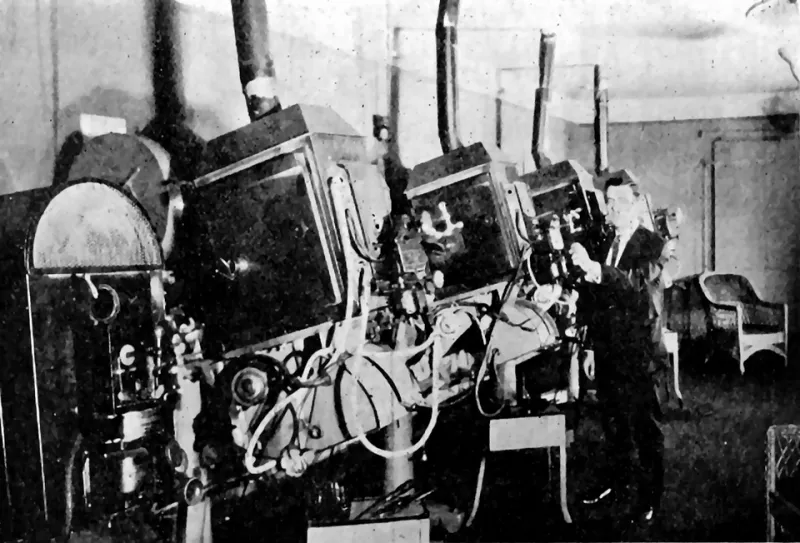
Photo: The Film Daily, Public domain, via Wikimedia Commons
At Happening, we spend a lot of time on the making of independent film: the coverage, the color, the sound mix, the festival strategy. But there is another craft layer that rarely gets its own panel — the last hundred feet between a finished file and a room full of strangers. That is the projection booth. And on a Saturday night in 2026, it is still one of the most quietly dramatic places in independent cinema.
I called a handful of working festival projectionists this fall — people who have run booths in Austin, Chicago, Portland, Brooklyn, and Denver — and asked a simple question: what actually happens when your short arrives? The answers were part technical manual, part hospitality gospel, and part cautionary tale.
The format is never just the format
A DCP is still the default at many festivals, but it is not the only guest at the party. Booth veterans described a typical day of ingesting encrypted DCPs, checking ProRes 422 HQ files, transcoding H.264 exports, and troubleshooting the occasional USB drive that arrives like a message in a bottle. One projectionist in Chicago said she has learned to read a filmmaker’s whole week from the folder structure. 'If the drive is named FINAL_FINAL_2,' she said, 'I know we are going to have a conversation.'
The failures are rarely exotic. More often they are ordinary: a 23.976 file in a 24-frame pipeline, audio mapped to the wrong channels, a short exported with bars baked into the frame, subtitles that sit below the visible area, or a playlist that points to a file the server cannot find. A film can look immaculate on a laptop and still arrive in the booth as a puzzle.
'People think the booth is a pass-through,' a projectionist in Portland told me. 'It is not. It is the last place where your movie gets interpreted.'
The rituals before the ritual
The best booths run on ritual. Before the doors open, there is a checksum, a second drive, a test playback, a volume check, a playlist lock. Some projectionists build what one called a 'house reel' — a few minutes of color bars, audio tones, and a title card — so they can confirm the room is behaving before a single short rolls. Others insist on watching the first thirty seconds and the last thirty seconds of every file. Not because they expect disaster, but because that is where disaster likes to hide.
'We do not need perfection,' a Brooklyn booth veteran said. 'We need predictability. Tell me the frame rate. Tell me the aspect ratio. Tell me if the audio is stereo or 5.1. Put a slate on the front. Put your contact info on the drive. Those small courtesies are not paperwork. They are the difference between a smooth screening and a lobby full of whispers.'
That phrase — lobby full of whispers — came up more than once. It is the sound of an audience trying to figure out whether the silence is intentional, whether the image is supposed to look that dark, whether the film has stopped or the projector has. Most of the time, it is not the film’s fault. It is a missed handoff.
The playlist is a score
Here is the part filmmakers rarely think about: the playlist is an edit. Order matters. Transitions matter. A tender ninety-second short can lose the room if the film before it ends on a blast of sound and the booth has not been given room to reset the volume. A comedy can die if it follows a film that leaves the audience emotionally flattened. Projectionists are not programmers, but they are often the last people to see the shape of the block.
One Denver projectionist said he treats every shorts program like a setlist. 'You have to leave space between songs,' he said. 'If every filmmaker wants their film to be the loudest thing in the room, the room stops listening.'
That is not an argument for sameness. It is an argument for communication. If your short has unusual audio, a quiet passage that must be heard, or a title card that needs a beat before it lands, say so. The booth can help. The booth cannot read minds.
What to send, what to ask
The practical checklist is less glamorous than a festival premiere, but it is just as real. Ask the venue for specs before you export. Confirm the delivery format, frame rate, aspect ratio, audio configuration, and deadline. Ship two drives if you are shipping at all. Label everything like a grown-up. Include a backup ProRes file when the festival allows it. Do not assume the booth has internet, a spare adapter, or a miracle worker on staff. And if you are hand-delivering, do not wait until ten minutes before the block to mention that the file on the drive is not the one in the email.
One projectionist told me about a filmmaker who arrived with a USB stick and a prayer. The film was beautiful. The file was a mess. They fixed it — barely — and the screening went fine. But the booth remembered. 'We will always try,' she said. 'That is the job. But the filmmakers who make it easy are the ones we can take care of best.'
The last hundred feet
The projection booth is not a bureaucracy. It is a collaborator. It is the place where your color grade meets a bulb, where your sound mix meets a room, where your eighty-nine minutes of work meets an audience that has no idea how any of it got there. The last hundred feet are not a formality. They are part of the movie.
So the next time you export, picture the booth. Picture the projectionist at 7:42 p.m., checking a checksum, cueing a playlist, hoping the room behaves. Then make their job a little easier. A clean file and a kind note will not make a bad short good. But they can keep a good short from dying in the dark — and that is still one of the best things independent film can ask for.