Prompt at Midnight, Premiere by Sundown: Confessions of a One-Day Film Crew
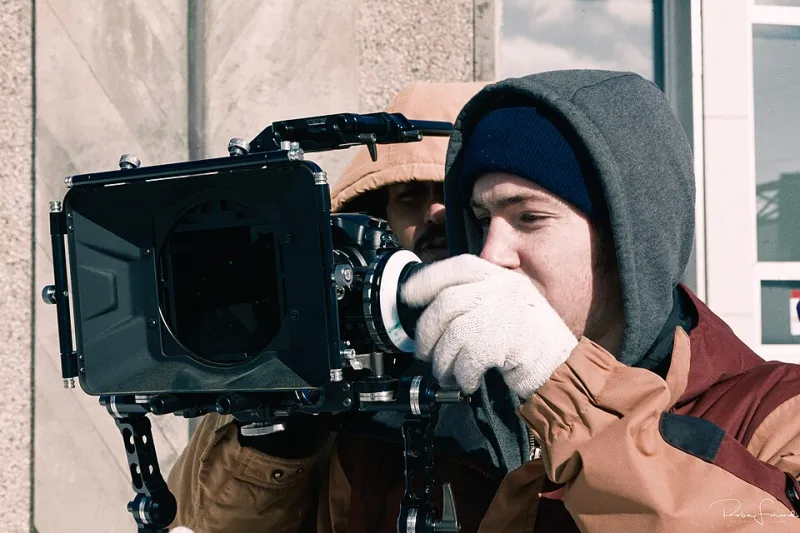
Photo: Robin Férand, CC BY 3.0, via Wikimedia Commons
At 7:03 PM on a Friday in a borrowed Portland warehouse, a man in a paper crown pulls a folded slip from a coffee can. "Heist film," he announces. "Required prop: a houseplant. Required line: 'That's not what we agreed to.'"
The team sitting cross-legged in front of him — five strangers who met forty minutes earlier — exchange the particular look of people realizing they've made a terrible, wonderful decision. They have until Sunday at 7:00 PM to deliver a finished, watchable short. Welcome to the underground economy of the film race.
The Rules Are Simple. The Experience Is Not.
If you've never encountered a 48-hour or 24-hour film project, the premise is deceptively lean: teams register, show up, receive a genre plus required elements, and race the clock. No pre-writing allowed. Everything — script, shoot, edit, score, color — happens inside the window. Miss the deadline and you're disqualified, no matter how gorgeous your footage looks.
Cities across the country run their own versions: Portland's long-running 48 Hour Film Project, Boston's 24 Hour Film Rally, Austin's caffeine-drenched iterations, dozens of college-town spinoffs. What they share is a promise that sounds like a contradiction — the strictest constraint in filmmaking produces some of the most liberated work you'll see.
Anatomy of a Sprint
Our Portland team — a barista, a high school drama teacher, a software tester, a retired paramedic, and a college sophomore — spends the first ninety minutes arguing in a Denny's parking lot. The heist premise survives. The houseplant becomes the MacGuffin: a rare orchid worth millions.
By 11 PM they've shot a two-page scene in the teacher's garage. By 2 AM the software tester, who has never color graded anything, is watching YouTube tutorials at double speed. The paramedic turns out to own a wireless mic kit. "Everyone shows up with one weird skill," the sophomore tells me. "You just don't know whose until you need it."
Saturday is a blur of locations — a laundromat that agreed via a hand-written sign in the window, a parking garage at golden hour, a chase sequence shot on a gimbal that's really just the teacher holding his breath. The smartphone footage, shot in log with a $40 anamorphic adapter, looks better than anyone expected.
Sunday morning is where film races go to die. The edit isn't working. The runtime is nine minutes of what should be six. The team cuts their favorite scene — a whole dialogue exchange shot lovingly at 2 AM — and the film snaps into focus. This is the lesson no film school can teach with the same force: kill your darlings on a deadline, or don't finish at all.
Why This Counts as an Education
Skeptics call these events gimmicks. The people who run them, and the many who've graduated from them, disagree. The skills under pressure — improvised problem-solving, working with what's in the room, finishing — are precisely what stall out most aspiring filmmakers for years. The industry term is "development hell." Film race veterans call it Tuesday.
Several race alumni have parlayed their shorts into festival selections, representation, and crew work. But the more common outcome is quieter and arguably more valuable: people who stop waiting for permission. The team from Portland submitted their orchid heist to three festivals. It got into one. They're already planning the next race.
As the drama teacher put it, zipping up a camera bag at 6:47 PM with ninety seconds to spare: "Film school teaches you to talk about movies. This teaches you to hand one in."
The next kickoff is probably happening in a city near you. Bring a houseplant. You never know.