Two Chairs, One Room, All the Drama You Need
There's a moment that happens at almost every filmmaker meetup in America. Someone pitches their short—a sprawling sci-fi epic, a heist with twelve locations, a crowd scene requiring forty extras—and someone else, usually the person who just got into Sundance, quietly mentions their film is about two sisters arguing in a kitchen.
Guess whose film got made.
The Superpower Hiding in Plain Sight
Here's the uncomfortable truth the gear-obsessed corners of the internet don't want you to hear: the two-person conversation is the most reliable engine in short-form cinema. Not the drone reveal. Not the practical blood gag. The conversation.
Think about the shorts that have lingered with you. Chances are, most of them came down to two humans sharing space, and the air between them getting thicker by the minute. That's not an accident of budget—it's the format working as intended. A short film has maybe ten minutes to earn your pulse rate. Nothing spikes a pulse faster than watching two people who can't say what they mean try anyway.
Scarcity Is a Spotlight
When you only have two actors and one room, every glance becomes a plot point. Every pause gets a camera. This is the dirty secret of restraint: it doesn't reduce intensity, it concentrates it, the way a magnifying glass concentrates sunlight.
A wide ensemble piece spreads your audience's attention across a dozen storylines. A two-hander funnels all of it into a single channel. The viewer starts reading micro-expressions like a detective reads a crime scene. Did her jaw tighten? Did he look at the door? That's not minimalism—that's maximum cinema happening at a microscopic scale.
Locking two characters in a room also builds automatic pressure. Someone wants to leave. Someone won't let them. Or nobody wants to leave, which is its own kind of trap. Whether it's a breakup, an intervention, a confession, or a negotiation gone sideways, the structure writes itself. Your limitations handed you a plot for free.
The Kitchen Table Film School
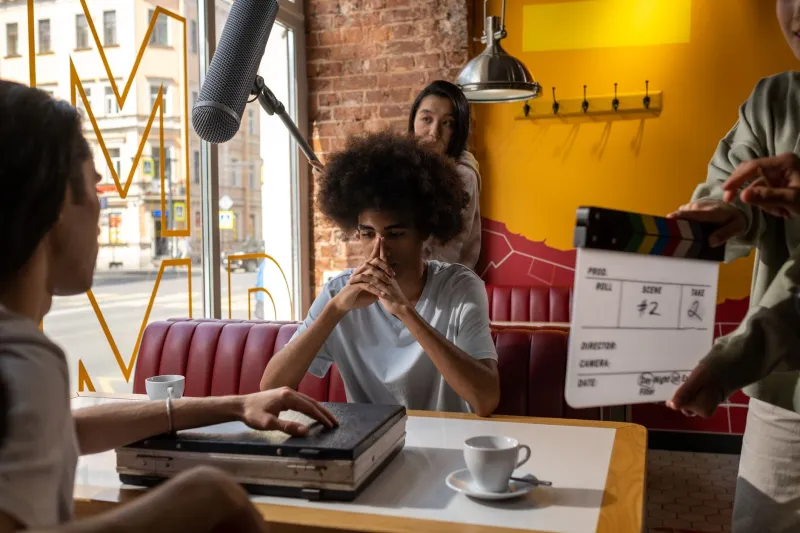
Look at the lineage. Some of the most celebrated shorts of the last few decades are essentially recorded conversations—two people at a diner booth, in a parked car, over a kitchen table. Festival programmers know this. They watch thousands of submissions a year, and the ones that survive the cut are rarely the ones with the biggest set pieces. They're the ones where, three minutes in, you realize you'd pay to eavesdrop on this conversation forever.
There's a reason theater figured this out centuries ago. Two characters, one space, an unresolvable argument—that's the whole DNA of drama. Short film just borrowed the blueprint and added close-ups.
How to Weaponize the Two-Person Scene
If you're writing a micro-budget short, here's the honest advice: stop treating your tiny cast as a compromise and start treating it as a design spec.
Give them history. The best two-handers aren't about strangers meeting. They're about people with ten years of scar tissue who need to talk about Tuesday. Backstory does the heavy lifting your budget can't.
Make the room matter. A conversation in a generic living room is just talk. A conversation in the apartment one of them is about to lose? Now the walls are arguing too. Choose your location like it's a third character—because on a two-person shoot, it might be the only other one you can afford.
Let the silence do shots. With no crowd scenes to cut away to, you're free to hold a face for six full seconds. Most directors never get that permission. You have it. Use it.
End before it's resolved. The two-person scene lives on the unresolved. If they figure it out, the spell breaks. Let them walk away mid-sentence and let the audience carry the argument home.
Small Isn't the Ceiling—It's the Frame
There's a lingering insecurity in the indie world that a two-person short is what you make before you make a "real" film. Flip that. The two-hander is a real film. Arguably it's the purest form of the medium: performance, tension, and time, with nothing to hide behind.
You don't need a warehouse or a stunt coordinator. You need two actors who can act, one location with something to say, and a script that knows what everyone in the room is afraid of. That's it. That's the whole budget.
The next time someone tells you your idea is "too small," tell them what the festival circuit already knows: nothing on screen is ever smaller than two people in a room—and nothing is ever bigger.